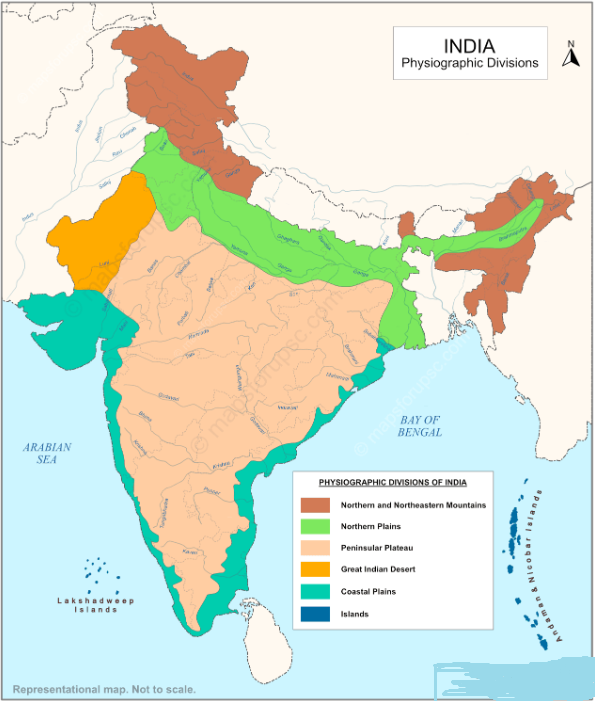
India has a highly diverse physical landscape, ranging from the Himalayan mountains in the north to the coastal plains and island groups in the south and southeast.
Understanding India’s physical geography is important for students preparing for OPSC, OSSC, OSSSC, Odisha Police and other competitive examinations.
In this lesson from Odisha Exam Trick, we explain the six major physiographic divisions of India with the help of a map, important features and easy-to-remember revision points. Odisha_Exam_Trick_6_Physiograph etc….
https://www.youtube.com/watch?v=KoEoUa3bkSs
The Six Physiographic Divisions of India
1. Northern & Northeastern Mountains
This region is mainly represented by the Himalayan mountain system and extends eastward into the Purvanchal hills. The Himalayas are geologically young fold mountains and strongly influence India’s climate and drainage. Odisha_Exam_Trick_6_Physiograph…
Remember: Young Fold Mountains
2. Northern Plains
The Northern Plains, also known as the Indo-Gangetic-Brahmaputra Plains, were formed by sediments deposited by the Indus, Ganga and Brahmaputra river systems and their tributaries.
The region is known for its fertile alluvial soil, level terrain and importance for agriculture. Odisha_Exam_Trick_6_Physiograph…
Remember: Alluvial Soil + Fertility
3. Peninsular Plateau
The Peninsular Plateau is an ancient tableland made largely of old crystalline, igneous and metamorphic rocks. It includes the Central Highlands and Deccan Plateau, along with smaller plateau regions such as Malwa, Bundelkhand, Chota Nagpur, Telangana and Karnataka. Odisha_Exam_Trick_6_Physiograph…
Remember: Ancient + Stable + Minerals
4. Great Indian Desert
The Great Indian Desert lies to the west of the Aravalli Hills. It is characterised by an arid climate, sandy terrain and sand dunes. The Luni is the principal large river associated with this region. Odisha_Exam_Trick_6_Physiograph…
Remember: Arid + Sand Dunes + Luni
5. Coastal Plains
India has coastal plains along both the Arabian Sea and Bay of Bengal.
The Western Coastal Plains are generally narrower, while the Eastern Coastal Plains are broader in many areas and contain important river delta regions. The coastal regions are important for agriculture, ports, fisheries and trade. Odisha_Exam_Trick_6_Physiograph…
Remember: Deltas + Ports + Trade
6. Islands
India’s two major island groups are Lakshadweep in the Arabian Sea and the Andaman & Nicobar Islands in the Bay of Bengal.
Lakshadweep is primarily made up of coral islands, while the Andaman & Nicobar Islands have important strategic significance and rich biodiversity. Odisha_Exam_Trick_6_Physiograph…
Remember: Coral + Strategic Importance
🧠 One-Line Revision
| Physiographic Division | Easy Revision Point |
|---|---|
| Northern & Northeastern Mountains | Young Fold Mountains |
| Northern Plains | Fertile Alluvial Plains |
| Peninsular Plateau | Ancient & Mineral-Rich |
| Great Indian Desert | Arid Sandy Region |
| Coastal Plains | Deltas, Ports & Trade |
| Islands | Coral + Strategic Importance |
This quick comparison and one-line revision are also included in the study material for faster exam preparation. Odisha_Exam_Trick_6_Physiograph…
🎯 Exam Memory Chain
Mountains → Plains → Plateau → Desert → Coasts → Islands
Remember this sequence and you can quickly recall the six major physiographic divisions of India during revision. Odisha_Exam_Trick_6_Physiograph…
🎥 Watch the Full Video
Learn India’s 6 Physiographic Divisions in Odia with Odisha Exam Trick.
👉 Watch the video above and revise along with the map.
If you’re preparing for OPSC, OSSC, OSSSC, Odisha Police or other competitive examinations, save this page for quick Geography revision.
Odisha Exam Trick
Odisha Exam Trick brings exam-focused educational content covering Mathematics, Geography, Current Affairs, GK and other competitive-exam topics in Odia.